Sunday, 2 December 2012

Why Use Shot Lists. Storyboards and Scripts?

Shot lists
Shot lists show the type of shot, the number of shots and what is in the shot. They give direction for the cameraman as well as the director as to how the shot works, such as how to zoom in, or how to pan etc.  They also work well for planning out the film and allow for efficient filming due to the note like nature and the fact it acts like a checklist, making it easy to film all the parts which in one location regardless of whether it is in chronological order or not.

When filming, we have found that due to constrictions and limitations in the actual locations, specifically the size of them and fitting the tripod into enclosed areas (especially in the bathroom scene) which have meant that we had to change our shot types in order for them to work within these limits.

Our shot list meant that we could produce the storyboard much easier due to the exact description of the scene and editing. Furthermore, the shot list links with the script as well showing when to cut or when the shot changes during dialogue.

Storyboards
Storyboards are hand drawn/digital graphics which allow everyone involved in the film to pre-visualize the film (as it would look on screen) before it has actually been shot. They can be animated to allow for exact timings of shots and cuts etc to be shown.

Primarily, storyboards usually convey which characters are in the scene and their gestures e.g. waving their hand, the dialogue in the scene, the timings of cuts and the length of scenes and the actual type of shot used e.g. long shot, extreme close-up, graphic match etc. Storyboards are very useful throughout the production of an entire film, they can be placed in different orders to change the story of a film easily and allow for the writers to see how the story is affected.

My group has followed these conventions by producing hand drawn images which we have animated together allowing us to see how our opening will look before we actually film it. In creating a storyboard it has affected our shot list and script as it made us aware of mistakes we made or how the opening might look better if we tried something different. For example, we found that in looking at our storyboard, we could make changes to shots to show greater variety in their use. 

Going into greater detail, we included a master shot which is a shot which is referred back to throughout the film, in our case, Adam or 'The Tester' tied to a chair.

Scripts
Scripts are produced to detail how the whole film works in it's audible and visual elements. The dialogue of the characters, filming location and cues to cut to the next scene are all important parts of the script. All of these elements help not just the director, but the editor and actors. For example, the director needs to know logistically how the whole film will be filmed, the editor needs to know how the scenes all work together and finally the actors need to obviously know their dialogue, character and emotions they need to portray.

My group has followed the conventions of script writing by using the standard layout and formatting of scripts used in films i.e. New Courier font, centering dialogue, and capitalized, abbreviated scene locations etc. We also did not include camera shots or angles, as these are detailed in the storyboard and shot list, which makes great sense as the actors in a film will not need to know about how the film will be edited. The script is indispensable when it comes to knowing how all of the dialogue fits together along with characters actions and costume , whilst providing an overview of how the film will fit together. 

Friday, 30 November 2012

Fight Scene Analysis

Although we do not have a lot of time for a long, drawn out fight scene; we thought it best to research some other Thrillers that have fight scenes to see how they handle it in different ways.

We have found a good tutorial on fight scenes where some examples of big budget films are used: http://www.youtube.com/watch?v=W4r5Mvlukhk

Through watching this we have come up with some ideas, first and foremost it is important to use different camera angles e.g. POV, over the shoulder shots to be able to create a fast paced sequence of a fight that really captures the audiences imagination; making them think they have actually just witnessed a fight. We will attempt to do this through a long shot of Adam creeping up to Kieran to stab him, followed by some close ups of him in the motion of trying to knife Kieran.

Secondly, it is important to establish a sense of realism as in a real fight, people tend to stumble slightly or swing and miss unless they are particularly good fighters. So we intend for Kieran to block Adam’s hand as he tries to knife him, as we are aiming for some realism in our opening.

Thirdly and finally, we will possibly slow down some of the action in the editing process to reinforce the gritty brutality we are aiming to convey in our Thriller. This will allow more emotion to be seen, as it is usually missed in normal time. We may also possibly speed up a clip as this will contribute to a faster pace which will then subside as Adam is disarmed.

After an ellipsis edit, Adam will take his knife out and then try to stab Kieran while he as his back turned. He will then manage to slice him on the wrist from which he will begin to bleed. After this we will use a technique where Kieran did a blocking punch into Adam’s abdomen, whilst stamping on the ground to give a more brutal sounding punch. This was all filmed behind Adam as this then stops Kieran’s fake punch being seen.

Pictures of finished fight scene:


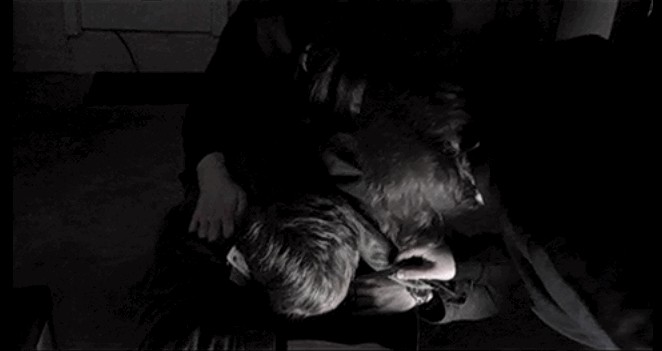
Here we see Adam swing the knife at Kieran, and, through analysing other films' fight scenes; we knew it of great importance to use a variety of shots in a small space of time to create drama and pace. These are critical to a good action scene. Especially since we have time constraints.


The two cuts together form a match on action which allows us to show where Kieran gets cut (his wrist), and also we added a slicing sound to add a bit of 'shock value'; thus adding to the gritty brutality we have been going for.


Here, we utilized blocking to prevent the audience from seeing that Kieran does not actually punch Kieran - this is done by Kieran punching near Adam, and then Adam reacts accordingly to the impact that the punch would make if it was real. 


Kieran also stamped his foot when he threw his fake punch, which we then added to with a punch sound effect. Coupling these together beefed up the overall sound in the mix. Also, if we had not managed to find a good punch sound then the original sound would have done the job just fine.

The punch and then Adam's fall combine to make a 'cause and effect' edit, which adds pace and allows us to cut to the next shot where Max holds Adam down onto the table.
 With the punch obviously disarming Adam, Kieran gets his knife and then threatens Adam until he tells the two gangsters where the drugs are hidden; resulting in a successful interrogation, and a successful fight scene.

Storyboard

Storyboard from Adam Nixon on Vimeo.

Synopsis

The Tester
The story revolves around a ‘tester’ of drugs. He takes more than his fair share and his dealers chase him down as he owes them money for what he has stolen from them. He ends up stashing some within his friend’s house putting them into a web of crime and mystery.
Adam wakes up tied to chair startled and looks confused. Tries to gnaw/untie the ropes tying him to a chair. A flashback occurs of him walking out of his house and begins to stroll down the street. It goes back to Max questioning Adam about something. Flashes to Adam arguing with some guy swearing etc. It then comes back to Kieran punching him and his chair fall over and he cries. Flashes back to him walking off and he gets abducted by Kieran and Max with masks on. (Opening titles appear every time a flashback occurs. Flashbacks could be in black and white with sound bridges.)
Whilst in their custody he is questioned and then beaten with a shovel. Finally an ellipsis edit then shows Max getting dressed. He looks at the mirror and adjusts his tie to make him look more smart and professional. Max then opens up the mirror to reveal a pistol being stored in there which he picks up, cocks and places inside his jacket. He then picks up his keys from the radiator and unlocks the door showing Kieran waiting for him outside.

Thursday, 1 March 2012

Research into Thriler Conventions


Proppian character types
Villain
Often a murder and of a similar age and level of intellect as the hero.
E.g. Castor Troy in Faceoff
Dispatcher
May be someone in a higher position of power than that of the hero, or in the case of Faceoff, there may be no need for a dispatcher as the hero has their own motives.
Helper
Anyone who’s giving of information leads to the capture of the villain e.g. a mole.
Princess/prize
The capture/killing of the criminal
Father
May fulfil the same role as the dispatcher in the case of thrillers
Donor
May play the same role as the helper
Hero
Often a middle aged, intelligent detective
E.g. Detective Mills in Se7en
False hero
Could possibly be a rival detective working on the same case as the hero or one who fails to achieve equal status.
E.g. Detective Mills in Se7en

Claude Levi Strauss’s binary oppositions
Good Vs evil
Successful career Vs failing career
Knowledge Vs ignorance
Criminal Vs police
Hero Vs villain

Todorov’s narrative theory
Faceoff
Equilibrium-Sean Archer is happy in the company of his son.
Disruption-Castor Troy murders his son.
Resolution-Castor Troy dies and Detective Archer’s quality of life is improved.
I am Legend
Equilibrium-The lives of Robert Neville’s family and the rest of New York City’s lives are going as they usually do.
Disruption-A virus mutates the residents who were not evacuated.
Resolution-He develops an antidote, gives it to a fellow survivor who escapes, and blows himself and the mutants up.

Thriller opening titles
Psycho
The film starts with the iconic image of the production company’s-Paramount Pictures-logo, which is a common convention of all films, not just thrillers. The name of the director-Alfred Hitchcock-is also shown, being introduced by white bars and then leaving by the same means. This means that the titles are pieced together, just as the plot of the film is, and also suggest that viewers may have to ‘read between the lines’.

The names of the main characters are then shown in the same sans serif font, as well as the screen writer director of photography and the names of all the individuals who played a key role in the making of the film. However, many more roles are mentioned than are typically included in modern films; they are normally left for the ending credits. The name of the composer of the music that sets the tone of the film is also mentioned, as well as once again the name of the director.

Sunday, 19 February 2012

The Film Industry – Institutional Research & Planning Tasks

-->
USP

The actors starring in, or the director of a film, may be its unique selling point, as the audience will expect their level of work to be consistently good. Many directors are associated with a particular genre, for example the Wachowski Brothers with Science Fiction/action after their success with the Matrix trilogy. Given this success, it would be fair to expect that the film they are currently working on-‘Cloud Atlas’-will also be a success. The USP for a film may also be that it is based on a popular book, just as ‘Cloud Atlas’ is. An example specific to the thriller genre is Alfred Hitchcock; he is seen as a pioneer and known as ‘The Master of Suspense’, so his work is obviously of quality. These factors will affect how the film is publicised and sold.

Find out which media institutions might produce, distribute & exhibit
A such as Se7en (big budget Hollywood thriller)
Distributor: New Line Cinema
Budget: $33 million
Gross box office takings: $100,125,643
Number of screens released on: 2,528

A big budget British film such as Casino Royale (big budget British thriller)
Distributor: Columbia Pictures
Gross box office takings: $167,445,960
Number of screens released on: 3,443
Budget: $150 million


A low budget British thriller such as The Disappearance of Alice Creed
Distributor: Isle of Man Film and CinemaNX
Gross box office takings: $166,980
Number of screens released on: 12 theaters
Budget: N/A


Pulp Fiction
Distributor: Miramax Films
Gross box office takings: $107,928,762
Number of screens released on: 1,494
Budget: $8 million


Q. You can use these examples but find others too. What does it show you about the production, distribution & exhibition systems and how Hollywood and the UK film industry are interlinked?

A. Films are usually produced by film studios and with a partnership with the distributer. Famous distributers such as 20th Century Fox usually invest in films with a very large budget. Those that don’t, such as ‘The Disappearance of Alice Creed’, usually obtain funding from either Film4, The National Lottery, or The British Film Institute who now administer the funding that used to come from the UK Film Council.

It is obvious that films funded by larger, more well known companies will be more successful than independent film. An example of this can be seen in the comparison of ‘Shutter Island’ and ‘The Disappearance of Alice Creed’: ‘Shutter Island’ took $294,804,195 worldwide, had a budget of $40,000,000 and its largest release was in 3,356 theatres. ‘The Disappearance of Alice Creed’, on the other hand, took just $867,714 worldwide, had a significantly lower budget and had a widest release of 12 theatres.

Q. Look at the posters and trailers for these films save and analyze the logos the companies have used here. How have they signified their genre in these designs? Upload logos of companies who would produce and distribute your film

Optimum Releasing’s logo is comprised of various shades of black and white signifying the binary opposition of crime and the law, with a grey background behind the word ‘canal’. This links to the conventions of the thriller genre, as they often use chiaroscuro lighting. The swirling pattern creates a sense of movement and looks very similar to that seen in the opening credits of ‘Vertigo’ and  the word ‘optimum’ implies that they produce the best films released as a subsidiary of Studio Canal.


Q. Think about the type of thriller you want to make and who would produce and distribute your film, stating why they would be appropriate.

A. I would choose Optimum Releasing, as they are well established and have had recent success with films such as ‘Tinker Tailor Soldier Spy’, especially since it win several awards at the Baftas, as well as success in the past with films such as ‘Man Hunt’. These things would increase the potntial audience and therefore profit, something that is important as the film indstry is a business. Another option would be Miramax films, who have lots of experience with the crime thriller sub-genre, with films such as Pulp Fiction and No Country For Old Men.


Shot List


Fade from black into Adams eyes.
Zooms out to a mid-shot to reveal Adam tied to a chair.
Close up of his hands trying to get free.
*Flashback*
Over the shoulder shot as Adam walks away from the camera.
*Present*
Close up of Adams face.
Match-on-action shot of Kieran/Max going through a door.
Long shot of Adam struggling more, desperate to get free.
A two shot of two black silhouettes opposite of Adam.
POV of Adam as Kieran walks towards him
Over the shoulder shot showing Adams reaction.
Cuts to a long shot of Max in the corner.
POV whip pan from Adam looking at Kieran and Max as they ask questions.
2 shot reverse shot
*Flashback*
Long shot of Adam walking down the street.
Two shot of Adam handing something to some guy.
Different angle of Adam swearing and walking away.
*Present*
Fade back
Close up of Adams face as Kieran punches him.
Slow motion as he hits the ground and a tear rolls down his cheek (extreme close up).
Mid shot of Adam on the floor.
POV from Adam looking at Kieran 


The shot list, along with the script and storyboards, make the job of the director easier than it would be without them and provides a clear structure that ensures the production can be filmed
 effectively.

Synopsis


The Tester
Adam wakes up tied to chair startled and looks confused. Tries to gnaw/untie the ropes tying him to a chair. A flashback occurs of him walking out of his house and begins to stroll down the street. It goes back to Max questioning Adam about something. Flashes to Adam arguing with some guy swearing etc. It then comes back to Kieran punching him and his chair fall over and he cries. Flashes back to him walking off and he gets abducted by Kieran and Max with masks on. (Opening titles appear every time a flashback occurs. Flashbacks could be in black and white with sound bridges.)
Adam says, ‘if you kill me,’ zooms into his lips, ‘you will never get the “…...” ’
The story revolves around a ‘tester’ of drugs. He takes more than his fair share of drugs and his dealers chase him down, as he owes them money for what he has stolen from them. He ends up stashing some within his friend’s house putting them into a web of crime and mystery.

Script


INT. DARK ROOM – NIGHT
Adam is seen confused and bound to a chair in a dark room. He tries to free himself but fails.
EXT. STREET – DAY
Flashback of Adam walking down the street.
INT. DARK ROOM – NIGHT
Max questions Adam about something.
MAX
Where is it?
ADAM
Where am I? Who are y-
KIERAN
That doesn’t matter! You owe us!
MAX
You know what you owe us.
EXT. STREET – DAY
Flashback of Adam arguing with someone. He hands over a partially empty bag of drugs and he acts aggressively towards Adam.
INT. DARK ROOM – NIGHT
Kieran punches Adam and he fails to the floor, still bound to his chair and he cries.
KIERAN
You know what you owe us!
MAX
Don’t kill another tester.
EXT. STREET – DAY
Flashes back to him walking away from the angry man. He then gets abducted by Kieran and Max with masks on.
INT. DARK ROOM – NIGHT
MAX
Just tell us and all of this will be over…
ADAM
It’s at my friend’s house. 22 White Lane.
MAX
Thank you. …Kill him.
Bang.
INT. BEDROOM – DAY
Shows Max getting ready for work but zooms out from the window and reveals Kieran watching/waiting.

We followed the conventions of a script, with locations being alligned to the left in capitals and with either interior or exterior specified, and with character names also in capitals, but alligned in the center, along with dialogue.

Friday, 17 February 2012

Student production analysis

Ufello films’ logo appears on a black screen in a hand written, white font, which contrasts with the black background. This characteristic is a classic thriller convention which Levi Strauss introduced called binary opposition. In addition to the font and background, there are also two blue lines that appear to have been smudged. The colour blue often connotes coldness, and within the thriller genre, enigma-another common feature. A crescendo occurs at the end of the logo which adds tension to the following scenes. The production logo then fades out and reveals the word ‘presents’ which is out of focus, possibly to further suggest mystery, just as the colour blue also does. A long establishing shot of a bus stop next to a main road is shown showing the area in which the events of the film opening are going to take place. This fades to the logo for Touchstone Films which gradually zooms in and then fades into opening scene.

A long shot of a girl walking past the camera and coming towards the bus stop at a fast pace with a worried look on her face, denoting distress and that something may have gone wrong, is seen. A straight cut to her walking into the shelter follows, whilst the camera slowly zooms into it. A mid shot of the girl shows her taking her phone out of her bag and then an over the shoulder shot of her entering a phone number is seen. A parallel edit shows a mid-shot of-due to his non-verbal codes- what appears to be her boyfriend on a sofa giving, suggesting that he is the one she is ringing. A further straight cut shows her holding her phone up against her ear waiting for him to answer. The use of parallel editing then shows him pulling his own phone out. A shot reverse shot then shows their phone conversation. She seems rather worried and anxious as she talks to him and insists that he comes to see her straight away Fast paced editing and a prolific use of close ups of the girl’s face shows her emotions, creating tension.

Her apparent boyfriend gets up and the walks to the bus stop with a long shot showing him walking away as if he is walking into danger and away from his safe home. He walks to the bus stop with his hands in his pockets indicating that he is rather relaxed. He then begins to seem quite agitated and nervous when the girl isn’t there waiting for him. A point of view shot shows him surveying his surroundings, looking for her or any sign that she has been near. At the end of the POV shot, a non-diegetic percussion instrument can be heard, creating enigma and mystery. He sits down and scratches his head, which has connotations of confusion. He takes his phone out of his pocket and begins to dial her phone number, indicating that he is concerned about her and wants to establish her location.

He proceeds to phone his friend, and this is seen through an over the shoulder shot, in which he says “hey babe where are you?” The word ‘babe’ indicates they are close and further suggests that he is her boyfriend. This means that her disappearance may have more of an effect on the reader than if hey hadn’t, through the Kulshov Effect. While he is talking on the phone, the camera zooms in so we can focus on his non-verbal codes, which adds to the sense of terror. We hear a diegetic sound from the phone-the name - “James”- that is enigmatic, as it clearly isn’t his girlfriend, from the voice heard. He then looks confused in his non-verbal codes, with his scratching his head etc. Alien-like music emphasises the mystery of the proceeding shots and the ring he finds forms another enigma as to where his friend is. These enigmas are a common convention of the thriller genre, as well as serving the purpose of adding mysteries to the overall plot. 

He then walks out of the shelter to see if anything is behind him and then we see a POV shot from the antagonist and possible abductor’s perspective, which zooms out, making the actor appear isolated and helpless. He then shouts “Sasha” and then the same style of POV shot used earlier, along with a whip pan, again connotes that he is helpless and there is no one within his surroundings to help him.
The editing noticeably speeds up as he hears “James” again. Alternating between the POV shot from his point of view and the POV shot from the antagonist’s point of view, and the camera tracking to show the antagonist’s movement out of the bushes, steadily builds tension. He then looks away from the protagonist, and the protagonist’s POV is shown once again This time as the antagonist gets closer, a non- diegetic sound of a metallic echo is heard, again, heightening the tension.

A hooded figure is then seen from a long shot. His dress code hides his identity, creating enigma, which is another convention of the thriller genre; the antagonist’s identity is often not revealed until the end of the film. He runs around the bus shelter and both him and the protagonist disappear as a car drives past on the main. The title of the opening “Cast in Shadows” is then shown, and again it uses a convention of the thriller genre- binary oppositions- which is between the black of the background, and the white of the text connoting, a struggle between good and evil, from what has been seen in the opening itself.

Whilst analysing this student production, we noticed particular aspects of it in which we would like to put into our film and other aspects which we would leave out. They make good use of enimgas within the film surrouding things such as where the girl has gone, the identity of what appears o be a kille and how he lnows James' name. If it was a full length film, rahter than just an opening, such enigmas would keep the audience watching, waiting for the answers to be revealed. They also used sound effects well and made them fit into the mood of the production, which helps build up the atmosphere with the strange noises. We also noticed that they zoomed into the locations as the character entered and this appeared to look quite effective, so we will probably replicate that shot in our film.

However, we noticed there was a lot of shaky camera movements as if it was done by hand when it shouldn't of been, or as if the camera has been nudged, which isn't very professional. The story itself isn't very gripping which makes it hard to keep interest when watching the opening, a thing which can detirmine for some people if they will enjoy the film or not, which in turn affects the films overall success when looked at as a form of entertainment, not merely a generator of money.

Cast In Shadows Opening


Cast In Shadows Opening Scene from Adam Nixon on Vimeo.

Monday, 6 February 2012

Se7en analysis

Seven begins with an animated logo of the distributers-New Line Cinema. The logo works well within any film due to the film reel graphic. That, and the colours used in the logo are representative of thrillers, with black and white-the struggle between good and evil, and the mysterious backlight behind the graphic of the logo is realistic and akin to chiaroscuro lighting which is a common convention of the thriller genre.

The film begins with a sound bridge of police sirens from a black fade to the kitchen of detective Somerset (Morgan Freeman), we instantly recognise that he is the protagonist due to his white outfit and white kitchen connoting purity and cleanliness. This also links with his organiszed, almost obsessive compulsive, personality, as he has everything organiszed just the way he likes it and it lacks a homely feel. A binary opposition ins also present in the scene with the chessboard; the black and white opposing each other suggesting the struggle between good and evil, which is another main convention of the thriller genre which the film will include. It also suggests a high level of intelligence for both Somerset and the antagonist, as the two of them need to be equally matched in order for the conflict to be sustained.

The editing for these scenes is rather slow paced which may be connoting the way his life is at home-it is either where he winds down and recovers from work by relaxing, or his work is his life, so his home life is rather sterile and lonely. In the following shot we see he spends a lot of time getting ready, as he does up his cufflinks and straightens his tie in front of the mirror from an over the shoulder medium lose up shot. His OCD nature is again highlighted with the almost militaristic line up of his possessions which he requires for his job, most notably his badge which indicates that he is a detective.

We see in the next shot both his bed and his suit. His bed is as single, confirming that he lives alone and is asingle man, and it’s in an almost perfect state to say he’s just got out of it (again showing his compulsive tendencies), and he then picks a hair off his suit jacket, showing that he not only has obsessive rituals, but he is also a perfectionist. He then turns off a light showing that he is leaving and an ellipsis edit is used, creating a contrast with the next scene, as we as the audience aren’t ‘eased into’ the violent aftermath in the next shot with a fade, as well as creating a contrast with the slow pace of his home life.

Straight away, we know it is a crime scene due to the dead body and the pools of blood. We know that it was a shooting due to the blood splatter on the window. The crime scene is set within an apartment which appears to be in a poor area due to its squalid state. Somerset then begins to inspect the apartment, paying attention to every detail, perhaps causing more work for himself by doing so. This shows that his obsessive, perfectionist attitudes at home carry over to his working life. The use of selective focus in this scene highlights Somerset as the protagonist, as the other detective is left blurred in the background, showing he isn’t as important.

His colleague doesn’t agree with his tendencies, as indicated by him telling Somerset that he cannot wait for him to retire. This lets us know that he is going to retire soon, but also wonder what he is going to do with the rest of his life because his job seems to control his personality and purpose. A new character comes up the stairs, Mills (Brad Pitt) and then a close up of him indicates that he is of some importance. His clothing includes a leather jacket and he is chewing gum, suggesting a more laid back attitude to Somerset. Mills immediately identifies and begins to talk to Somerset with shot reverse shots showing their conversation. In the background behind Somerset metal bars and fences around the windows can be seen, indicating they are in a dangerous area. 

There is then an ellipsis edit to the outside of the building where diegetic police sirens and radios can be heard once again. The way in which this is handled, however, makes it seem like a common occurrence. More bodies are then seen being carried out of the building, denoting death. The pathetic fallacy of the rain ties in with this, indicating that bad things are happening and perhaps indicating that a storm is coming. Somerset and Mills are seen walking along the street with the camera tracking their movements. They are both seen at a low angle, connoting authority and dominance, although Somerset is in the foreground of the shot, perhaps showing that he is the more experienced of the two. Realism is added to this scene with the abundance of people walking across the x axis and obstructing the view of the audience. Mills’ movements appear more anxious than Somerset’s in the way he is walking and in his gestures, perhaps due to the fact that his isn’t too focused, as he is new to the area. He also gets knocked into by a lot of people whilst Somerset calmly strolls whilst avoiding passers-by. Mills attempts to show that he is experienced and the right man for the job, but Somerset sees through him, as he has more experience and knows what it takes to be a good detective. He then tries to defend his point of view by stating that he has been working on homicides for a while, but Somerset dismisses this, telling him that the area he worked in contrasts greatly to where they are both currently.

Another ellipsis edit cuts to Somerset in his bed, showing him on is own and that there is little to his life other than his work. Alarms are once again heard, showing that it is a dangerous area and that is also a regular occurrence. He puts down his glasses and in the corner of his room a bookcase full of books is seen; both of these items reinforce the idea of his high intellect, as the chase board in the opening shots also did. The activation of his metronome is then seen in a close up shot and it may serve the purpose of indicating the slow, regular pace of his life. Metronomes also stay in time regardless, showing his OCD nature once again. It is really monotonous just like his life, connoting that his life is the same thing over and over again; his job has taken over his life. The diegetic sound of dogs barking and alarms can still be seen, providing a contrast between order and chaos and showing Somerset’s need for regulation, with the metronome drowning it out. Close ups of Somerset’s face are then seen with the metronome alternating, as if it is his mind ticking.

The screen then goes completely blank and a non-diegetic sound effect of thunder is heard, acting as pathetic fallacy once again and suggesting a disruption in the order of Somerset’s life. The opening credits then begin with an image of a book and the pages turning over. On top of this some industrial music is played (Nine Inch Nails-Close remix) which creates a tense atmosphere. As the names of the credits appear, the chosen font looks to have been scratched on, making it appear eerie, just as the suddenly fast pace of the editing also does. All the images used are spliced together like a montage and show the grubby hands of the character in the scene who seems to be the antagonist. A lot of sharp objects such as a razor are also seen and the antagonist is seen to be cutting off his fingerprints, so no trace is left behind, connoting that he knows what he’s doing and that he’s on the same intellectual level as Somerset, therefore making the film more interesting to watch. He is the opposite to Somerset in the binary opposition of good versus evil and he is clearly the evil aspect, as shown by the use of dark imagery and the fact that Somerset is obviously a detective-the job commonly held by the protagonist in the thriller genre. The opening credits show his progress in an atmospheric fashion and depict him as being psychopathic, especially as he is seen blanking out words and cutting up pictures and removing the identity of people and dehumanizing them by means of drawing over their eyes. Some of the words he blanks out include ‘intercourse’ and ‘transsexual’ showing that he doesn’t approve of this and that he is psychologically disturbed. 

The antagonist is seen binding a book together with bandages around his fingertips’ this seems like an abnormal act as he is binding his own journals together when he could simply buy one. The scene ends with him cutting out the word ‘God’ from a dollar bill with the song finished with the only lyrics “you get me closer to God”. This may connote that the antagonist perhaps believes he is doing God’s work and that he is some form of messiah. It ends with a fade and resumes with a long shot with the use of a blue filter and the inclusion of tall office buildings of the city landscape, showing that it is set in an urban area, which is a common setting for thrillers, though we already knew this from the opening .